
Advising Frequently Asked Questions

Registration

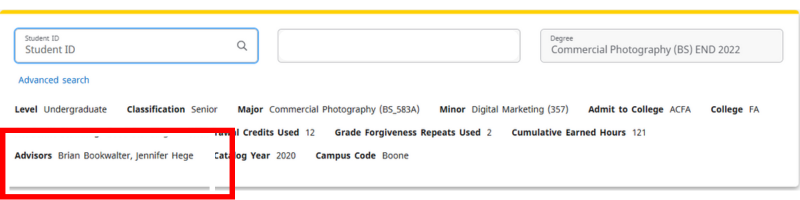
Your assigned advisor is listed in your DegreeWorks audit.  

Degreeworks

You can count only 46 hours above the core / general education curriculum requirements in any one discipline toward your degree.

For example, if you have 52 hours toward your Sustainable Development, Environmental Studies BA, you would need to take enough courses outside the department to reach 120 hours without counting the extra six hours within your discipline. To graduate, you would need 128 hours total to account for the extra 6 hours you took within your department.

One thing to remember is that any courses used to meet core / general education requirements don’t count toward the 46-hour limit, even if these courses are within your major department.  So, if you have taken SD 2400 to meet core / general education requirements, we would say only 49 hours were taken in the major.  In that case, you would need 125 hours to graduate.

BA students, keep careful track of your hours. If you need extra elective hours to reach 120 or 122 based on your catalog year, make sure you choose ELECTIVES OUTSIDE OF YOUR MAJOR DISCIPLINE.


Minor

The BA degree requires a minor outside the academic discipline of the major.  A BA Art student must have a minor from outside the Art discipline.  The minor can be from a College other than the College of the major. 

A student may formally declare a major when she or he has earned 30 semester hours, successfully completed RC 1000 and UCO 1200, and has a cumulative GPA of 2.0 or higher

  1. Log into AppalNet.
  2. Select the Self-Service tab.
  3. Select the Student  tab.
  4. Click on Student Records.
  5. Click on Declare Your Major.
  6. You will need to enter a phone number, your major and a minor if it is required for your major.
  7. You can enter a second major, but keep in mind that you will need to complete that major or have it removed from your record at a later date.
  8. You will be notified via email once your records have been processed.
  9. After declaration, your records will be moved your declared major department and college, and you will no longer have an assigned advisor in University College.  You may be able to find your new advisor in your DegreeWorks audit.

If you are not eligible to declare, you will get an error message. If you are unclear on why you were unable to declare, contact your University College advisor (listed in DegreeWorks) or call the Advising Office at 828-262-2167.

Students will need to complete the change of major process for the college they seek to change or add a major in.  

If you are unsure of which college the new major is housed, please visit Appalachian’s Undergraduate Programs website to find out and then use the list below to request a major change.

If you are currently a declared student in the College of Fine & Applied Arts and seeking to add or change a minor you must complete the FAA Add/Change Major or Minor Form on our website.

If you are a student whose major is not declared in the College of Fine & Applied Arts and seeking to add or change a minor,  you must complete your respective college's process.  

No, not all majors require a minor.  Comprehensive majors do not require a minor because more courses within the major are required.  You can view your Program of Study or the Undergraduate Bulletin to determine if a minor is required or recommended.  Also, consulting with your advisor is beneficial. 

Each semester, continuing students have the opportunity to register for future term courses prior to new students. This is known as Early Registration, and typically occurs in early November for spring registration and early April for summer / fall registration. The timeframe typically lasts 11 business days and the Registrar's Office provides students with day and time to register based on accumulated earned credits (institutional and transfer).  Your current credit hours are not included in this total, as they are not yet earned. 

You may view you registration appointment time in AppalNet by clicking on the Check Your Registration Status page under the Student tab. 

You may also view your registration time by visiting the Office of the Registrar's website.

Holds are placed on a student's account to restrict access or use of an academic function (i.e., registration). Holds are placed for a variety of reasons including unpaid balances, parking tickets, library fines, disciplinary action taken by the Office of the Dean of Students, etc.

You are able to determine what hold(s) are placed on your account and which office to contact to resolve the hold by Logging into AppalNet > clicking on Self-ServiceStudentStudent Records / Student Account.

Students are required to meet with their faculty or professional advisor each semester to discuss your goals and aspirations, post-graduation plan, and courses.  You will be given your Registration PIN during your advising appointment after which you can register on your scheduled day and time.

In the College of Fine and Applied Arts, academic advising is mandatory for students who seek to be readmitted to the college. Once you have been advised by your advisor and the advisor notifies the Dean's Office, you will be contacted by the Registrar's Office through your Appalachian email address notifying you when you are eligible to register for courses. 

You will not need a PIN to register for courses the semester you return, but depending on the department of your major, you may need a PIN for future semesters. Your advisor will inform you if a PIN is necessary.

The Undergraduate Bulletin, also known as the course catalog, is an online reference to help you understand university requirements, policies and course descriptions. It can also answer questions you may have about prerequisites, majors, minors, general education, which semesters courses are offered and more. 

A student's catalog year is the year he / she began attending Appalachian State University, not the year the student declared a major.  The Program of Study and Four-Year Guides for a major / minor / general education must follow the same catalog year.

Students may change their catalog year by completing the Add or Change Major / Minor / Catalog Year Form on the College of Fine and Applied Arts website if they are currently declared in the college.

You can also view your catalog year in DegreeWorks.

Beginning Fall 2014 for all undergraduate students, the policies for repeating courses and for grade forgiveness are defined as:

RepeatAny course taken more than one time; students only earn credit hours ONCE for a course, regardless of the number of times the course is taken; all repeated courses are included in attempted hours
Grade ForgivenessRemoving the grade from the GPA calculation once a course is repeated; the grade stays on the transcript, but the GPA calculation excludes the course; the hours are included in attempted hours; there is a limit of four grade forgiveness courses (must be different courses) and the first grade is always the one excluded

Repeats

  • You may only earn credit hours ONCE per course, regardless of the number of times the course is taken 
    (A few courses are repeatable for credit if the content changes. These are indicated in the Undergraduate Bulletin course descriptions)
  • If you repeat a course that you originally passed and fail the repeat, you will lose ALL credit and grade for the course
  • If you already have credit for a course at Appalachian State University, you cannot take the course again at another institution and transfer it to Appalachian State University

Grade Forgiveness

The first four courses you repeat will AUTOMATICALLY be processed as grade forgiveness courses. You will not have to complete a form to have your first grade excluded from your GPA calculation.

  • If you have already used some "repeats" as grade forgiveness, this does not mean you get four more!  You will only be allowed 4 total, so if you have already used 2, you will have only 2 more
  • If you don't want to have a course repeat automatically processed as a grade exclusion, you must complete a form before the end of the Drop/Add period for the term (1st five days in fall/spring; 1st or 2nd day in summer). You can find the Grade Forgiveness Exception form on the Forms page.

Exclusions

  1. Grade forgiveness can be used only once per course 
  2. Only courses taken at Appalachian are eligible for grade forgiveness
  3. Grade forgiveness may not be used on courses that have changed their content or credit hours

Questions may be directed to the Records Area of the Registrar's Office at (828) 262-2051

A full-time semester for an undergraduate student is defined as 12-18 semester hours in fall/spring, or 12 semester hours during the summer (6-7 hours in a five-week summer term).  Anything above this is considered an overload. 

An undergraduate student may be granted approval from his/her Dean’s Office to take an overload if the following GPA requirements are met:


UG Credit Overload 
         (per term)

Cumulative GPA
Fall/Spring19 semester hours
20 semester hours
2.5
3.0
Summer8 semester hours
9 semester hours
2.5
3.0


Process to Request an Overload

Student must login to their AppalNet account
Click the Student Tab, Registration link, and then Request Overload link
Select the term which overload is needed and complete the form, then press Submit      

**Any exceptions must be approved by the associate dean

Some course sections will offer a waitlist option to students who can sign up for via AppalNet once the section is closed.  The purpose of waitlisting is to allow students the ability to easily monitor courses they need that are closed without having to frequently check back on AppalNet. 

Waitlisting will not be available for every course and being on a waitlist for a section does not guarantee the student will get a seat in that course. 

If you are seeking to register for a course but the course is closed, you can add yourself to the waitlist if offered.  When you add yourself to the waitlist, you are made aware of the capability to waitlist, waitlist capacity, and current rank.  If an additional seat is created or a student drops the course, the Registrar’s Office notifies the next student on the waitlist via Appalachian email to register for the course.  The student then has 18 hours to register themselves into the course, otherwise they are dropped from the waitlist and must register again if they miss that timeframe.

Please visit the Registrar’s Office website for FAQ’s regarding waitlist.

A course may be added after the published Drop / Add period only for extenuating circumstances and requires the written permission of the instructor,  department chairperson and associate dean.

Student must complete the Late Drop / Add Form identifying the reason for the late add and have all of the required signatures before submitting it to the Dean's Office for final approval. 

The form must be submitted to the Dean's Office within TWO (2) business days of obtaining the department chair's signature.

Students may freely drop and add courses during the first five days of the fall and spring terms without using any Withdraw credits. From the sixth day until the end of the ninth week of the fall and spring semesters, students may withdraw from 16 hours in their entire academic career at Appalachian. These are called withdrawal credits.

You may use up to 16 withdrawal credits directly in Appalnet. No form is needed:

  1. Sign into AppalNet 
  2. Click on the Student tab.
  3. Click on the Registration menu.
  4. Once in the Registration menu, select Withdrawal Information.
    1. Classes may be withdrawn by using the options available in the Action field.
    2. If no options are listed in the Action field, the class may not be dropped (i.e., all drops have been used or it is too late in the semester to drop classes).
    3. Once all changes are made, click on Submit Changes.

It is a good idea to sign out of AppalNet and sign back in to review the registration to ensure the drop has been completed. You may not claim that a drop was not processed as a reason to drop a class late; it is your responsibility to verify a drop was processed.

If you have accumulated four career drops and attempt to drop another course, the drop will be denied and you will remain enrolled in the class.

Students who audit a course must be regular in attendance.  A Request to Audit form is available in the Registrar's Office. It must be completed by the student, approved by the faculty member teaching the class, signed by the Dean's Office in which the course is housed, and submitted to the Registrar's Office by no later than the last day to add the course in that term.

The Pass/Fail option may only be taken by a full-time undergraduate student one course per semester, up to six (6) times during their academic career at Appalachian.

Stipulations which limit this policy are:

  1. Student must be classified as a sophomore, junior, or senior
  2. Student must have a minimum cumulative GPA of 2.0
  3. Student must be enrolled full-time, defined as taking a minimum of twelve hours
  4. Student will be allowed to choose this option a maximum of six times
  5. Courses which comprise the student's major, minor, or core curriculum requirements cannot be taken on pass/fail (only free elective courses may be taken as pass/fail)
  6. A student who elects the pass/fail option may remove the pass/fail option during the first nine (9) weeks of the fall/spring term
  7. If a course was originally taken under the A-F grading system and is repeated, it must be repeated under the A-F system
  8. A passing grade does not figure into the GPA, but a failing grade does
  9. Pass/fail forms must be submitted to the Registrar's Office prior to the close of Drop/Add period

Students need to fill out Visiting coursework in Appalnet to obtain prior approval.

Students may petition to have any course designated as Elective credit equated to a specific App State course, by initiating the Transfer Coursework Petition process.  Please see Transfer Services for complete information and the Petition for Transfer Credit Form.

Yes, students who wish to place out of a course should consult with the department chairperson of the course in question. Not all courses are subject to credit examination.

If arrangements can be made, a fee of $50.00 is charged for each examination and must be paid to the Student Accounts Office in the John E. Thomas Building. The original receipt must be submitted to the department chair with the Credit by Examination Form before final approval can be given.

Anyone seeking credit by examination must be either degree seeking or taking courses for teacher licensure. Credit by examination cannot be used to repeat a course, nor can it be used to meet the university's residency requirements for graduation.

If the examination is passed, credit without grade will be noted on the student's transcript. If the examination is not passed, no notation is made on the transcript.

Log into Appalnet -> Student tab -> Academic Records - > Unofficial Academic Transcript

Official transcripts can be ordered through the registrar's website below.

Contact the Office of the Registrar.

Fall / Spring Semesters

For undergraduate students, a full-time course load is at least 12 semester hours, but no more than 18 semester hours.

Summer Sessions

For undergraduate students, a full-time summer term is at least 6 semester hours, but no more than 7 semester hours (two terms are offered each summer).

Student dropping to part-time enrollment should consider financial aid, University provided health insurance, International students, on-campus housing, study abroad and tuition. Students please remember dropping below full time enrollment can impact the time till degree completion.

Yes, you can take classes online if they are offered. 

To search for all courses that are offered online, you can visit the Class Search webpage > select the term > in Schedule Type select Web Based-Entirely (100).

This will show all courses that are offered online during a particular semester.

You can find the day and time your final exams on the Registrar's website.

Some majors require a certain number of free electives in order to meet the minimum credits to graduate. Free electives count towards degree requirements to ensure students earn 120 credits. 

Courses may be used to satisfy more than one requirement across the major, minor, and general education requirements, subject to a few restrictions. If the course meets a requirement in your major and may also meet a requirement in your minor or general education, it will satisfy all of the requirements. However, the course will only earn credit hours one time and may leave you short of the minimum credits required for the degree, resulting in the need for additional elective (s).


General Education

Only nine hours (sometimes 10 hours) in the major academic discipline may be double-count in general education and the major.  Programs of Study and Four-Year-Guides will include information on the courses that may double-count.

For example: If the Program of Study lists five courses (3 sh) each, that may double-count, you may only use three courses (9 sh). 

MajorIf a major restricts double-counting courses in any way, it will be noted on the Programs of Study
MinorSome minors do not allow sharing between the minor and General Education requirements.  The minor Programs of Study will specify this information

Financial Aid

Fall / Spring Semesters

In order to be eligible for full federal, state and institutional aid, students must be enrolled full time, which is defined as 12 credit hours per semester.

Students must be enrolled part time (defined as a minimum of six credit hours per semester) to be eligible for any federal financial aid, such as Pell Grants and student loans.  

Summer Sessions

Students must be registered for a minimum of six  semester hours during the summer to be eligible for financial aid.  It does not matter if the student is enrolled in all six hours the first summer session, three hours in Summer I and three hours in Summer II, or four hours in Summer I and two hours in Summer II.  

Students are encouraged to contact the Office of Financial Aid for further information on eligibility and qualifications.

In order for students to meet Satisfactory Academic progress (SAP) at Appalachian, they must earn at least 67% of their total attempted institutional credit hours.  If a student does not meet 67% SAP, he/she will be placed on “SAP warning” (which in written form will appear as “academic probation warning”) and will be sent an academic probation warning mailer to his/her permanent address at the end of the semester.

An Academic Probation Warning is NOT the same thing as Academic Probation (though it is possible to have both a SAP warning and be on Academic Probation). The purpose of the warning is to ensure that students are informed that continued failure to meet expected SAP ratio could have future consequences in terms of their GPA and financial aid eligibility.

To view more about Satisfactory Academic Progress on the Financial Aid Website, click HERE

Please contact the Office of Student Financial Aid if you have additional questions or concerns related to your financial aid.

Financial aid can only be awarded to courses that are required for a student's degree. If you have required electives, you can take extra classes to fulfill those elective requirements.  Once you have fulfilled those elective requirements, you can not take extra classes to receive financial aid. If our office determines you are receiving aid for courses that are not required at any point during the semester, your aid will be recalculated which may result in a balance owed to the university

Students seeking to withdraw should contact the Office of Student Financial Aid and view Appalachian’s Withdrawal Policy to determine how current and future financial aid may be impacted.

Dropping to Zero Hours

If you withdraw from the university, you must contact the Registrar's Office to begin the official withdrawal process and establish your withdrawal date. If you stop attending classes, you are required to officially withdraw. If you stop attending classes but fail to complete the official withdrawal process, you will be considered an unofficial withdrawal.

Please note that you may be considered a withdrawn student for financial aid purposes if:

  1. You enroll in one or more courses that do not span the entire length of the semester; and
  2. You enroll in one or more courses that do last the entire semester; and
  3. You drop the course(s) that lasts the entire semester after you have completed the course(s) that does not span the entire semester.

The Financial Aid Office will be notified when you drop courses and are no longer enrolled in any other courses. Based on the Return of Title IV funds calculation, you may be required to repay all or a portion of the financial aid you received.

Dropping Hours During Drop / Add

If you are an undergraduate, generally, your financial aid is based on an enrollment status of 12 or more credit hours per semester during the academic year, or a total of six credit hours for summer terms. If you are a graduate student, generally, your financial aid is based on an enrollment status of nine or more credit hours per semester during the academic year, or a total of five credit hours for summer terms. If you drop below the respective enrollment status during a drop / add period, your financial aid will be adjusted according to the credit hours you are enrolled in as of the end of the drop / add period.

Dropping Hours After Drop / Add

If you drop hours (not to zero hours) after the end of the drop / add period, your financial aid will be adjusted only if you are allowed to receive a refund of tuition and fees. Please note that if you are a current or previous Federal Direct Loan borrower with an in-school deferment status and you drop to less than six credit hours as an undergraduate student or less than 5 credit hours as a graduate student, you will go into your six-month grace period to repay your Federal Direct Loan.

Unofficial Withdrawal

An unofficial withdrawal is a student who does not successfully complete any courses (receives all F grades or U grades), stops attending classes and does not complete any coursework as of the 60% point of the semester or summer term without officially withdrawing from the university, as required. An unofficial withdrawal may be required to repay up to 50% of the financial aid received for the term.

Students who never attended any classes and did not complete any coursework are required to repay 100% of the financial aid received for the semester or summer term.

Students who stop attending all of their classes are required to officially withdraw from the university.

Be sure to review Appalachian's Withdrawal Policy.

Scholarship applications, deadlines, and criteria vary from department to department.  Please click on the departments below to search for scholarship information specific to your department:

Study Abroad

Enrollment PurposesStudents studying abroad for a semester are required to be enrolled in at least the equivalent of 12 or more Appalachian credit hours to maintain full-time status. Students will also need to follow the minimum full-time enrollment requirement for their host university / program, which in many cases might be more than 12 credits.  
Financial AidStudents should speak to their financial aid counselor in the Office of Financial Aid to see if they are eligible for financial aid.
Research It's critical students research the country / city / institution they're thinking about studying abroad in so they're not surprised when they get there.  The main goal is they have an enjoyable and comfortable experience while studying in a different location.  
ScholarshipStudents can apply for various scholarships from The Office of International Education and Development

The Office of International Programs conducts in-person and online Study Abroad 101 Workshops for students planning to study abroad.  The workshop reviews program types, tips on how to find a program, costs, coursework and approvals, scholarships, financial aid, and the application process.  Students are encouraged to attend these workshops for more information.