
While traveling to Scotland this Spring to attend the Steps Change toward Sustainability Conference in Perth, Dr. Laird Christensen, Chair of the Sustainable Development Department, took advantage of the chance to meet with other sustainability educators. At the University of Edinburgh he met with faculty from the Department of Social Responsibility and Sustainability, and the Manager of the university’s interdisciplinary Climate and Sustainability in the Curriculum program.
“I was excited to meet the folks in Edinburgh,” says Christensen. “They’ve been global leaders in sustainability in higher education for some time, and were ranked fourth in the world this year in the Sustainability QS World University Rankings. I was very impressed by the work they’re doing there – but it also helped me appreciate how inspiring and effective our own Pathways to Resilience Quality Enhancement Plan is here at App State.”
 Christensen also had a chance to meet with faculty and students in the Centre for Living Sustainability at the University of Highlands and Islands in Inverness. While there he gave a presentation, "Catching Up, Keeping Up, Looking Ahead: The Adaptive Sustainability Curriculum,” arguing for the need to keep adjusting university courses and curricula to respond to changing conditions in a warming world.
“I’ve been designing and directing programs in Environmental Studies and Sustainability for twenty years,” he says, “and the pace of environmental change has picked up dramatically, especially over the last decade. Climate disruption is no longer an emerging threat. It’s part of our daily reality.”
In response he has added courses in emergency management, resilience planning, and water resource management to previous programs, as well as courses that emphasize specific skills such as stakeholder engagement and applied systems thinking. He is now working with faculty in the Sustainable Development Department to refocus or create courses that respond to the latest emerging challenges – although, he notes, in some areas the curriculum is already ahead of the curve. He mentions Dr. Aniseh Bro’s course on climate change and migration, which he describes as a challenge that “will require both resettlement skills and deep transformations in the way we understand our relations and responsibilities for the displacement for others.”
“Our students are hungry for the skills that will prepare them to be a part of the transition to a more just, sustainable way of life. And while there are no simple solutions to a problem as complex as global climate disruption, he adds, “we can help our students learn to isolate and address specific aspects of systems that are out of whack. Problem-solving at any level is empowering, and that gives us hope.”
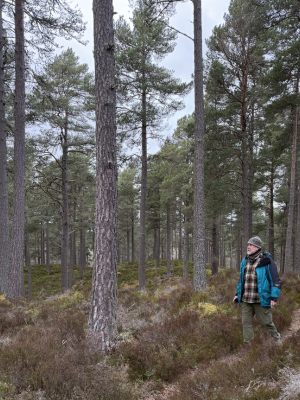
In addition to his time at Scottish universities, Dr. Christensen traveled to several Highland sites that continue to inform his writing and teaching. He visited Findhorn Ecovillage, the largest intentional community in Europe, which he has been teaching about for years in one of his most popular courses, Utopian Visions, from Eden to Ecovillages. He also explored Anagach Woods, a 250-year-old mature Scots pine woodland that has been operated by a community trust since 2002. Nearly 1,000 acres of Anagach Woods are immediately adjacent to the local village of Grantown-on-Spey, and while walking the trails and learning about the environmental education projects there Christensen couldn’t help but imagine the possibilities at Howard Knob, where the Blue Ridge Conservancy recently purchased land.
“I’d love to bring students up there at different points in the process of developing trails,” he says. “It’s a great opportunity to think about the values of access to undeveloped lands, to learn about bioregional history and environmental neuroscience, and just to get to know our neighbors.”
###
About the Goodnight Family Department of Sustainable Development
One of seven departments housed in the College of Fine and Applied Arts, the Goodnight Family Department of Sustainable Development at Appalachian State University prepares students to thoughtfully analyze human development while focusing on the applied practice of pursuing transformative, community-driven development with concentrations in agroecology and sustainable agriculture; community, regional and global development; and environmental studies; a Bachelor of Arts in sustainable development with a concentration in environmental studies; and a minor in sustainable development.
About the College of Fine and Applied Arts
Appalachian State University's College of Fine and Applied Arts is a dynamic and innovative group of seven academic departments, bringing together a variety of perspectives, experiences, and real-world education to provide unique opportunities for student success. The college has more than 3,500 undergraduate and graduate majors. Its departments are Applied Design, Art, Communication, Military Science and Leadership, Sustainable Development, Sustainable Technology and the Built Environment, and Theatre and Dance.
About Appalachian State University
As the premier public undergraduate institution in the Southeast, Appalachian State University prepares students to lead purposeful lives as global citizens who understand and engage their responsibilities in creating a sustainable future for all. The Appalachian Experience promotes a spirit of inclusion that brings people together in inspiring ways to acquire and create knowledge, to grow holistically, to act with passion and determination, and to embrace diversity and difference. Located in the Blue Ridge Mountains, Appalachian is one of 17 campuses in the University of North Carolina System. Appalachian enrolls nearly 21,000 students, has a low student-to-faculty ratio, and offers more than 150 undergraduate and graduate majors.

SD logo

SD logo