
Appalachian State University’s Frontline-to-Farm program is entering a new phase of growth as interdisciplinary collaborations offer opportunities to strengthen support for military veterans, farmers, and rural communities across Western North Carolina.
For the past five years, the Frontline-to-Farm program, which is focused on helping military veterans transition into sustainable agriculture while strengthening local food systems and rural communities, has been led by the Department of Sustainable Development and the Department of Communication within the College of Fine and Applied Arts. This year, Dr. Joseph Jakubek, Assistant Teaching Professor in Appalachian State University's Department of Sociology, joins Dr. Anne Fanatico with the initiative. The addition of sociology faculty will bring new perspectives in rural development and community-based research to Frontline-to-Farm's mission, expanding the program’s interdisciplinary reach and impact. The collaboration will also create new opportunities for student engagement through internships, applied learning experiences, and community-based projects that support both veterans and local agricultural producers.
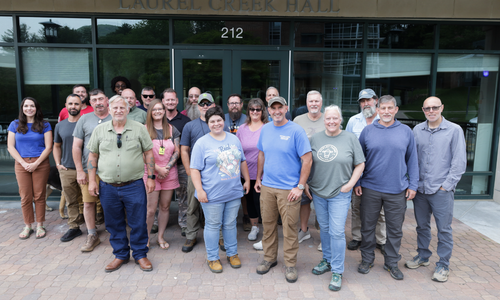 Frontline to Farm Beginner Farmer Training 2025
This expansion comes at a critical time for Western North Carolina communities still recovering from Hurricane Helene. In the wake of the hurricane, Frontline-to-Farm and Blue Ridge Women in Agriculture previously created the BRWIA/Frontline-to-Farm Producer Relief Grant to support rebuilding efforts by the region’s farmers. In total, the grant distributed $24,000 in donations to 12 local producers, aiding their abilities to continue providing locally sourced food to communities in the High Country.
In seeking to continue broadening its funding portfolio, the program is being supported in 2026 by USDA NIFA 2020-69006-31684 "Novel microbubble technology to reduce contamination of poultry products and fresh produce for small and medium veteran farmers, after initial funding from the U.S. Department of Agriculture's Beginning Farmer and Rancher Development Program. These investments will allow the program to expand outreach programming and community partnerships.
A final major development is the program's growing collaboration with the University of Connecticut (UConn). The team is also being joined by Dr. Abhinav Upadhyay, Associate Professor of Animal Science at the University of Connecticut. Together, App State and UConn are working to introduce innovative and sustainable technologies designed to support small-scale farmers. Among these innovations is the use of ultrafine bubble technology for sanitizing produce and poultry products, offering new opportunities to improve food safety and agricultural sustainability. This technology will be incorporated into Frontline-to-Farm’s annual beginning farmer training, being held at Appalachian State University June 8-12, 2026, which hosts local and regional producers during a week-long program focused on developing new sustainability practices.
As Frontline-to-Farm continues to grow, the partnerships emerging between the University of Connecticut, the College of Fine and Applied Arts, and the College of Arts and Sciences demonstrates Appalachian State University's commitment to interdisciplinary collaboration, rural resilience, veteran support, and innovation.
by Joseph Jakubek, Ph.D.
Assistant Teaching Professor, Internship Coordinator
####
Frontline to Farm is a grant-funded program at Appalachian State University. It provides beginning farmer training to military veterans. Please see www.frontlinetofarm.appstate.edu.
About the Goodnight Family Department of Sustainable Development
One of seven departments housed in the College of Fine and Applied Arts, the Goodnight Family Department of Sustainable Development at Appalachian State University prepares students to thoughtfully analyze human development while focusing on the applied practice of pursuing transformative, community-driven development with concentrations in agroecology and sustainable agriculture; community, regional and global development; and environmental studies; a Bachelor of Arts in sustainable development with a concentration in environmental studies; and a minor in sustainable development.
About the College of Arts and Sciences
The College of Arts and Sciences (CAS) at Appalachian State University is home to 17 academic departments, two centers and one residential college. These units span the humanities and the social, mathematical and natural sciences. CAS aims to develop a distinctive identity built upon our university's strengths, traditions and locations. The college’s values lie not only in service to the university and local community, but through inspiring, training, educating and sustaining the development of its students as global citizens. More than 6,800 student majors are enrolled in the college. As the college is also largely responsible for implementing App State’s general education curriculum, it is heavily involved in the education of all students at the university, including those pursuing majors in other colleges. Learn more at cas.appstate.edu.
About the College of Fine and Applied Arts
Appalachian State University's College of Fine and Applied Arts is a dynamic and innovative group of seven academic departments, bringing together a variety of perspectives, experiences, and real-world education to provide unique opportunities for student success. The college has more than 3,500 undergraduate and graduate majors. Its departments are Applied Design, Art, Communication, Military Science and Leadership, Sustainable Development, Sustainable Technology and the Built Environment, and Theatre and Dance.
About Appalachian State University
As the premier public undergraduate institution in the Southeast, Appalachian State University prepares students to lead purposeful lives as global citizens who understand and engage their responsibilities in creating a sustainable future for all. The Appalachian Experience promotes a spirit of inclusion that brings people together in inspiring ways to acquire and create knowledge, to grow holistically, to act with passion and determination, and to embrace diversity and difference. Located in the Blue Ridge Mountains, Appalachian is one of 17 campuses in the University of North Carolina System. Appalachian enrolls nearly 21,000 students, has a low student-to-faculty ratio, and offers more than 150 undergraduate and graduate majors.

Frontline to Farm Beginner Farmer Training thumbnail 2026

Frontline to Farm Beginner Farmer Training thumbnail 2026