
Visitors to the Hiddenite Arts & Heritage Center are experiencing something entirely new. Thanks to two major remodeling projects completed in 2025, the Center now features a dramatically renovated gallery and a fully realized Geology Information Station, both designed by students from Appalachian State University's Interior Design (AD) and Building Science (STBE) programs.
For the Center, located in the historic Lucas Mansion in Alexander County, these updates represent far more than aesthetic improvements. They mark a renewed chapter in a decades‑long partnership with App State- one that began with founder Eileen Lackey Sharpe's vision in 1981 and continues today through the leadership of Interim Director and Professor of the Interior Design Program and Center board member, Jeanne Mercer‑Ballard.
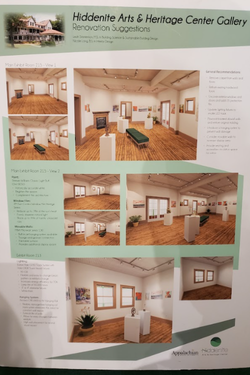
The first of the two projects began 2017, when Interior Design alum Nicole Long Edwards collaborated with Building Science students Leah Simmerman and Lindsay Rhoden to reimagine the Center's primary gallery. Their design, completed in 2025, has transformed the space into a flexible, welcoming environment that supports far more than art display.
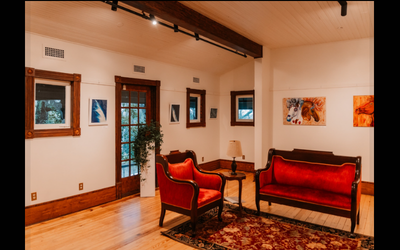
Today, the renovated gallery hosts field trips, lecture series, community events, and hands‑on programming. What was once a traditional viewing space is now a dynamic hub for learning and engagement.
"It is no longer just a place to view art," says Executive Director Kara Smith. "It's a versatile, inviting space that enhances how visitors engage with the Center as a whole."
The second project—the Geology Information Station—was designed in 2024 by Interior Design alumni Ari Gomez and Elliott Pegram during an Independent Study with Mercer‑Ballard. Their challenge was to transform two rooms in a 125‑year‑old historic home into an immersive geology learning environment.
The result is a space that feels like stepping into a mine. Visitors can examine mineral specimens up close, use microscopes, and interact with displays that highlight the rare geological anomaly that makes Hiddenite, North Carolina, one of the only places in the world where the gemstone, hiddenite, is found.
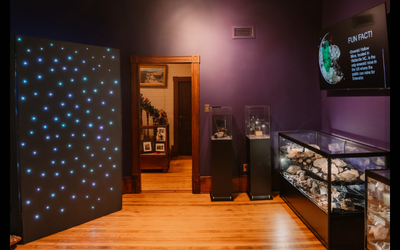
"These spaces shift us from a traditional, hands‑off museum model to a more immersive and welcoming environment," Smith explains. "Guests are encouraged to touch, explore, and learn. It sparks curiosity in a way that's truly special."
For the Center, these student‑designed projects directly support its mission: to educate the public about the natural and cultural heritage of Northwest North Carolina.
"They help us tell the story of our region in a more engaging and accessible way," Smith says. "And they honor our founder's original vision of building a strong relationship with Appalachian State University."
Smith notes that what stood out most in the collaboration was the creativity and range of ideas the students brought forward.
"Led by Jeanne Mercer‑Ballard, they presented multiple concepts—each one distinct, each one thoughtful. Their ability to blend respect for the Lucas Mansion's history with fresh, innovative ideas was remarkable."
The completed spaces have already reshaped the Center's programming and reach.
For youth:
In a rural county with limited field trip options, the Geology Information Station now offers hands‑on, curriculum‑aligned learning experiences for elementary, middle, and high school students.
For the broader community:
The remodeled gallery provides a flexible venue for events, workshops, and lectures—expanding the Center's ability to serve visitors of all ages.
"These projects have allowed us to broaden our reach and create more dynamic, inclusive experiences," Smith says. "They've made our Center warmer, more accessible, and more engaging for everyone who walks through our doors."
For the students involved, these projects represent something rare: the chance to see their ideas built, used, and loved by a community.
For the Center, they represent a renewed partnership with App State—one that continues to shape the cultural and educational landscape of Alexander County.
And for visitors, they offer something even more meaningful: spaces that invite exploration, celebrate local heritage, and make learning feel alive.
About the Department of Applied Design
One of seven departments housed in the College of Fine and Applied Arts, the Department of Applied Design at Appalachian State University fosters excellence in design education, design research, and professional placement. The department balances theoretical and pragmatic approaches while exploring an awareness of impact through design decisions on the global community. Faculty focus on a holistic approach to creative problem-solving by integrating sustainability and ethical responsibility in teaching and practice. The department offers bachelor's degrees in apparel design and merchandising, industrial design, and interior design.
About the College of Fine and Applied Arts
Appalachian State University's College of Fine and Applied Arts is a dynamic and innovative group of seven academic departments, bringing together a variety of perspectives, experiences, and real-world education to provide unique opportunities for student success. The college has more than 3,500 undergraduate and graduate majors. Its departments are Applied Design, Art, Communication, Military Science and Leadership, Sustainable Development, Sustainable Technology and the Built Environment, and Theatre and Dance.
About Appalachian State University
As the premier public undergraduate institution in the Southeast, Appalachian State University prepares students to lead purposeful lives as global citizens who understand and engage their responsibilities in creating a sustainable future for all. The Appalachian Experience promotes a spirit of inclusion that brings people together in inspiring ways to acquire and create knowledge, to grow holistically, to act with passion and determination, and to embrace diversity and difference. Located in the Blue Ridge Mountains, Appalachian is one of 17 campuses in the University of North Carolina System. Appalachian enrolls nearly 21,000 students, has a low student-to-faculty ratio, and offers more than 150 undergraduate and graduate majors.

Hiddenite Arts and Heritage Center thumb

Hiddenite Arts and Heritage Center thumb